


| Interview: | DUIR |
| Titel: | Level by level |
Given the high calibre of the music on „Catarsi“, it seems only logical that this impetuous horde from Verona should have secured a record deal for their second album. Folkloric Black Metal: rousing and wild, with catchy melodies, superbly executed, vocally razor-sharp and atmospherically airtight.
Just as their esteemed genre counterparts Belenos have come to represent for France over the years, Duir should now be able to achieve the same for their home country with ease.
The interview is led by MK (music composer, director and guitarist) and is answered in collaboration with the rest of the band: Vox in Umbra (vocals and lyrics), Skryer (guitar), T.Z. (flute, bagpipes and hurdy-gurdy) and P. (drums).
Congratulations on the label-deal, the upcoming 2nd album release and your return - how does it feel for you right now?
MK: It feels like a very important step for us as a band. The label deal and the upcoming second album are the result of a lot of work over time, so there is definitely satisfaction in seeing everything come together. At the same time, it also feels like a new starting point rather than a final achievement. There is still a lot we want to do and improve, so the focus right now is mainly on continuing to build on what we’ve done so far and making sure this next release represents us in the right way.
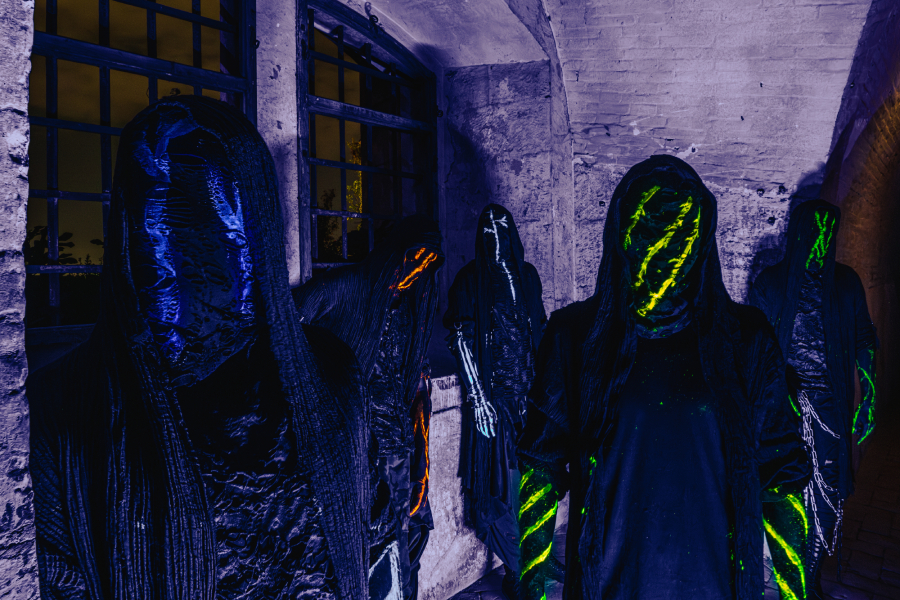
What would you like to say about your current black costumes with the different colored symbols?
MK: The black costumes represent the shadow and darkness that are at the core of our music and the themes we explore with Duir. It’s the base layer, the emotional and conceptual foundation of the band. The fluorescent symbols, instead, represent human emotions and different inner states. They are a way to give form to those feelings visually, almost like highlighting what exists within the darkness. Together, it’s a simple contrast: the shadow as the foundation, and the symbols as fragments of emotion emerging from it.
 How good and synchronized is the current band chemistry?
MK: At the moment, the band is at its strongest point in terms of internal relationships. We really feel like a single unit now. Everyone shares the same direction and the same goal, and that makes both the creative and working process much more focused and straightforward.
„Catarsi“ represents your most ambitious work yet, as the Promo says. Great new material indeed, I also admire the fully insane, extreme fierce vocals! How has your highly driving folkish BM style developed and what do you particularly like about it?
MK: Thank you, we really appreciate that. With „Catarsi“, our sound has definitely become more focused and more aware of its own identity. The folk elements now have a more central role within the songwriting, and the black metal side has become more cohesive in terms of structure and intensity. The development came quite naturally through writing and playing together more consistently. We started to understand better how to balance atmosphere, aggression and melodic elements without forcing any of them. What I personally like most about this style is exactly that balance. It allows us to be extreme when needed, but still keep a strong sense of melody and atmosphere throughout the songs.
It's sheer unavoidable for me to ask here about your inspirations regarding more or less famous bands within these genres.
MK: There are many different inspirations behind my music, coming from both black metal and folk-influenced scenes. Bands like Moonsorrow, Alcest, Saor, Panopticon, Ellende, Groza, Austere, Woods Of Desolation and Enisum (with whom I also collaborate as a session guitarist, and who have been a strong personal inspiration for me) have been a strong reference in more recent years, especially in terms of atmosphere, songwriting approach and emotional impact. Looking further back, bands like Draugr and the early Ensiferum albums had a big influence on me when I was younger, especially in how folk elements can be combined with extreme metal in a more direct way. Outside of metal, composers like Hans Zimmer and Howard Shore are also a major source of inspiration, particularly for their ability to build atmosphere and emotion through composition.
The story of the new album release, within WWI, the young soldier on his own cathartic journey, caught between pride, despair, and oblivion; how did you guys come to write these songs on this topic - based on a book, a movie, etc.?
Vox in Umbra: The inspiration comes from several sources. The location where we have our rehearsal room is an Austrian fort dating back to 1845, which has hosted thousands of soldiers over the centuries. On the walls, you can still see inscriptions carved during the First World War - soldiers’ names etched into the stone. This has been a powerful source of interest and inspiration for us, allowing us to relive certain stories through the places themselves. We also drew great inspiration from films such as '1917', books like 'All Quiet on the Western Front', and poetry - in particular the vast majority of Ungaretti's works, which we directly quote in the album's track 'Del Giorno'. From there, I let my imagination take over and create the character of Vox in Umbra - a soldier who is struck down during battle, but does not die... and yet does not survive either. He exists in a limbo that makes him a voice in the shadow - 'Vox in Umbra' in Latin means 'the voice in the shadow’ - narrating the stories, the sensations, and the fears of the soldier at war.
How can the readers imagine you writing, developing and finalizing one of the new songs?
MK: Most of the work starts from my side. I usually define the overall idea of the song and develop a pre-production in my studio. I start from a melody or a riff, and from there I build the rest of the structure, including the rhythmic parts and the melodic layers, as well as the folk instruments. Once the song has a solid form, I bring it to my bandmates, where it is further adapted and arranged together until we reach the final version. After that, Vox in Umbra develops the concept and writes the lyrics based on the finished song, shaping the narrative and thematic layer around what the music is already expressing.
 How do you see and evaluate this new album within your musical journey?
MK: We see „Catarsi“ as an important step in our musical journey. It’s not a radical change in direction, but more of a consolidation of what Duir is becoming in terms of sound, identity and songwriting approach. Compared to our earlier work, there is a clearer focus and a more defined structure in how the songs are written and developed. At the same time, we kept the core elements that have always been part of our music. For us, this album represents a point where things started to feel more cohesive and intentional, both musically and conceptually.
How was the selection of songs for the album done - was it difficult or rather easy for you?
MK: The selection process was quite natural. We didn’t really write a large number of extra songs to choose from, so most of the material we worked on was already intended to be part of the album. That said, we were still quite selective in terms of quality and coherence. If a song didn’t fully fit the direction or didn’t reach the level we wanted, it was either reworked or left aside. So overall it wasn’t particularly difficult, but it required a clear idea of what the album should sound like and what we wanted to achieve with it.
Guest vocals on „Impeto” by L.G. of Ellende - how did that come about, and what would you like to tell our readers about it?
MK: L.G. from Ellende is an artist I deeply respect, both for his role in the scene and on a personal level. His music had a strong impact on me and played an important part in shaping my musical perception over time. That was the main reason why I reached out to him for „Impeto”. The idea was also to create a connection between Austria and Italy, which fits the overall concept of the album set in the context of World War I. His contribution came very naturally. Even though we work with different languages, that was never a limitation. The way he uses his voice and language adds a very personal and authentic layer to the track. We are deeply grateful to him for being part of this song.
„Catarsi“ was mixed and mastered by P.G. of Groza at Ad Nauseam Sounds, "showcasing the band’s signature blend of haunting melodies and visceral intensity" - how did you find working together, and are you completely satisfied with the final result?
MK: Working with P.G. from Groza at Ad Nauseam Sounds was a very positive experience. He understood quite quickly the direction we wanted for the album and what kind of sound we were aiming for. The process was very collaborative. We had a clear idea from our side, and he helped translate that into a final mix that kept the balance between atmosphere, clarity and intensity. We are satisfied with the final result. It represents well what we had in mind for „Catarsi“ and gives the right space to all the elements of our sound.
 You’ve been quite active on the live scene over the past few years - what were some of the key experiences, learning processes, and lessons you’ve gained along the way?
MK: Playing live over the past years has been a very important part of our growth as a band. It helped us understand what really works outside the studio and how to translate our sound into a live context. We also learned how to deal with uncomfortable situations and unexpected problems, which is something you can only really learn on stage. It pushed us to become more professional in the way we handle shows and everything around them. Another important aspect has been the connection with other musicians. Building relationships within the scene is one of the most valuable things we gained from playing live.
What has changed most significantly in your attitude toward music and the music world since your „Obsidio“ EP start in 2018, one year before Covid, based on your experiences over the last years?
MK: A lot has changed since the time of the „Obsidio“ EP in 2018. Back then everything was still at an early stage, both in terms of experience and understanding of how the music world actually works. Over the years, especially through live activity and the development of the band, my approach has become much more realistic and focused. You start to understand what really matters and what doesn’t, both creatively and on an industry level. At the same time, there is more awareness now in how we write and present music. The process is more intentional, but also more natural, because we’ve gone through enough experiences to know what feels right for us.
Anything you would like to add?
MK: Just a big thank you for the interview and the interest in our band. We really appreciate the support.
© Markus Eck, 12.06.2026
Photo Credit: Duir
[ to overview ]


📢 𝗣𝗥 for artists & more since 2001
🎯 Consistent 5✭ rated
🌐 Worldwide reach:
print, online, radio
⫸ Many years of extensive and in-depth experience in various musical fields form the basis for individual and efficient services.
⫸ In addition to communications for global Public Relations, the main areas of activity are integrated Promotion Campaigns, as well as Marketing, Artist Management, Consulting and Mentoring.
👉 "An outstanding, passionate and genuine PR Agency, that is truly interested in its clients. Highly recommended!"
(HAND OF KALLIACH • UK)
See more feedback »
BlattTurbo
Bleeding4Metal
BURRN!
Crossfire Metal
Darkzen Dragon
Filthy Dogs Of Metal
Frenzy Fire
Groundcast
Heavy Metal Webzine It
Highwire Daze Online
Legacy
Metalheads Forever
Metal Gods TV
Metal Pedia
Metal Shock Finland
Metal Temple
Metal Titans
Metal Underground AT
MetalZone
Pete's Rock News And Views
Powermetal DE
Rock Garage
Saitenkult
Smorg Magazine
Sonic Realms
Stormbringer
The Cosmick View
The Murder Inn
Zephyr's Odem
1921 Baliheadbanger
Demontre Radio
Das Metalmagazin hart&direkt
Hijos De La Luna
La Caverna De Hierro
Metal Com Batata
PowerPlant Radio NL
Radio Diabolus
Rock Live Radio
🔻 Label Partners
🔻 Booking Partners
Linktree
Instagram
Facebook
YouTube
Pinterest
TikTok
Tumblr
Blog
Wordpress
Bluesky
Threads
X
Disclaimer
Impressum
Datenschutzerklärung
© Metal Message ᴳᴸᴼᴮᴬᴸ • 2001-2026 • All rights reserved
Unauthorized use and/or duplication of this material without express and written permission from this site’s author and/or owner is strictly prohibited.
Excerpts and links may be used, provided that full and clear credit is given to Metal Message ᴳᴸᴼᴮᴬᴸ with appropriate and specific direction to the original content.