


| Interview: | LOCUS NOIR |
| Title: | Letting Go with Love |
When he left the highly acclaimed Swiss Industrial Metal band Sybreed in 2013, singer Benjamin Nominet set out on a journey of self-discovery that would last quite some time.
That journey proved successful—since 2025, he has not only returned as the band’s frontman but, with Locus Noir, this powerful vocalist is also presenting his new band project, which, so to speak, has decisively led him back to himself!
The debut album „Shadow Sun“ has a wealth to offer. In a compact trio formation, the band members celebrate their emphatically emotional commitment to gothic rock in a touchingly nostalgic and invigoratingly pulsating manner, sealed by heartfelt, plaintive post-punk incantations.
As the main songwriter, Ben DMN — his stage name — is clearly feeling positively excited about the new release.
„I am thrilled to be back with ‚Shadow Sun‘, especially since this project is particularly close to my heart. The release of the album, and of Locus Noir itself, is not a comeback in the dramatic sense of the word; it is more about finally giving shape to something that has been maturing within me for a long time. After almost two years of work, it's a huge relief to see the album become a reality and start its own life. I'm grateful for the interest and reactions it's already generating, but most of all, I feel ready for what's next.“
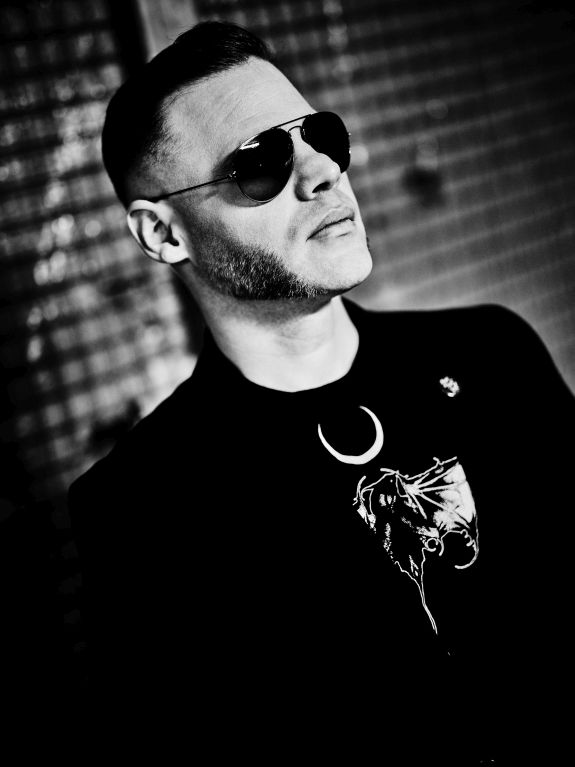 In a classic trio formation – how did you find each other, and how would you describe the band chemistry?
„The trio came together very naturally. Although I remain the main driving force behind the project, it was important for me to work with musicians I trust, both musically and personally. Interpersonal dynamics are just as important as technical skills, especially when considering the project in the long term. We share a similar commitment to music and a deep mutual respect. Ales and I have been collaborating for several years, and he seemed like an obvious choice for Locus Noir. I was looking for a bassist with a strong presence and a playing style in line with someone like Tony Pettitt, and Ales fits that profile perfectly. Drummer Ben Marmier and I have also collaborated sporadically in the past, and Locus Noir gave us the opportunity to consolidate this collaboration in a post-punk context. The core of the band is now firmly in place. I am currently in the process of selecting the live guitarist who will complete the lineup, and I already have some very promising prospects.“
"Type O Negative gloom, The Fields Of The Nephilim mysticism, and Paradise Lost melancholy, all infused with a post-punk edge.” How has your style developed, and what do you particularly like about it?
„My attachment to these bands, and more generally to a certain sound and atmosphere, dates back to my teenage years. Initially, I was more drawn to post-punk and gothic rock, and it was only later that I discovered music closer to Metal thanks to Type O Negative's album ‚Bloody Kisses‘. That album was a turning point for me, because it showed me that melancholy, atmosphere, and raw strength could coexist naturally. Since then, I've remained something of a maverick, halfway between the gothic subculture and the metal scene. Although I've spent most of my career in Metal bands, those initial influences never disappeared; they simply lay dormant. I always knew that one day I would have to explore them, but not through imitation or homage. It was important to find my own path, one that respected the essence of these influences while still being forward-looking. What I wanted to capture was very specific and corresponded precisely to what I appreciate in a certain type of darker rock: a kind of liturgical coldness, a taste for esotericism, and at the same time a certain ironic distance and anti-establishment attitude. This balance defines my relationship with this music today.“
What was your mood and vision when you started writing the album - was it inspired by today’s world, or more of a nostalgic journey?
„It wasn't nostalgia in the sense of looking back with regret, but rather continuity. I wasn't reacting directly to the state of the world, but I feel that something essential is often missing today: depth, patience, and a kind of passion for art that transcends immediacy. Writing ‚Shadow Sun‘ gave me the impression of reconnecting with a language that still means a lot to me. Many classic albums were recorded years ago, but that doesn't mean their emotional vocabulary is outdated. On the contrary, I think it's still very relevant, even necessary today. In that sense, this album has also been a process of rediscovering myself and consolidating my personality, at a time when the world itself seemed to be pushing many of us to question our own nature.“
How can readers imagine you writing, developing, and finalizing a song?
„It usually starts with a form of inner exploration, almost escapism in fact, often triggered by a mood, a mental image, or sometimes a simple chord progression or rhythmic pattern. From there, the song gradually reveals itself. At first, I work quite intuitively, letting things unfold without thinking too much. Once the structure is in place, I become much more analytical, refining the arrangements, vocal phrasing, and dynamics. Finalizing a song is above all a question of balance: knowing when to stop, when to add nothing more, and sometimes even knowing how to cut into the structure of the song. That said, I have no problem going through several iterations before considering a song finished.“
The lyrics move “between the esoteric and the intimate.” How did they come about - fiction or personal experience?
„They are rooted in my personal perception and life experiences, sometimes mundane, sometimes highly symbolic. I draw inspiration from moments I have lived through, emotions and observations, then transform them through my own aesthetic prism. Themes such as love and death, desire and decadence, nocturnal excesses and their consequences are universal, but they take on their full meaning when filtered through the self. The esoteric aspect creates a certain distance, while the intimate aspect makes the lyrics realistic and sincere. Some tracks are also directly linked to my relationship with the gothic subculture itself: friendships, shared experiences, real situations, etc. For example, Reburial can be interpreted both as a procession of nocturnal creatures returning to their lair, and as something much more concrete: the silent, almost ritualistic departure from a gothic party at dawn, with exhausted characters returning home after a long night.“
 What has changed most in your attitude toward music since the end of Sybreed in 2013?
„The most significant change is probably my perspective. I am less interested in confrontation and more focused on consistency and longevity. Music seems less like a battlefield and more like long-distance running. I've also become more selective, not only in what I listen to, but also in how I invest my energy. I place much more importance on depth, harmony, and sincerity than on visibility and performance display. That's why Locus Noir doesn't use any screaming in its songs: I wanted to sing with my real voice, without artifice and without a safety net.“
„Shadow Sun“ - a paradoxical album title. Could you tell us more about it?
„I have always been drawn to paradoxes. Shadow Sun evokes a light without redemption and a darkness that brings clarity. It reflects a process of confronting one's own shadow, not to glorify it, but to understand and integrate it. For me, it's more about lucidity than escape: a form of inner alchemy where opposites coexist rather than cancel each other out. Shadow Sun also represents a liminal space where outsiders can gather without having to justify themselves, a refuge where they are accepted as they are.“
How do you see and evaluate this album within your long musical journey?
„It seems like a completely natural step to me. It's neither a break nor a reinvention, but rather a convergence. Shadow Sun brings together many of the threads that have been present throughout my career, but expressed in a more focused way. It's probably one of the most coherent albums I've made, both artistically and personally. I have big ambitions for Locus Noir, not in terms of popularity, but because it seems essential and deeply necessary at this stage. I see it as the beginning of a new chapter, which I hope will be even more enduring than what came before.“
How was the song selection process - difficult or easy?
„Surprisingly fluid. I wrote more material than necessary, but the album quickly revealed its own internal logic. Some songs fit together naturally, others didn't. Once that consistency was established, the selection process became much easier. It wasn't necessarily about choosing the ‚best‘ tracks, but rather about preserving the balance and fluidity of the album. It is precisely for this reason that How Harsh Is the Light of Dawn does not appear in the main sequence of the album. It's a strong song, but it didn't share the same ritualistic essence as the rest of the work, which unfolds from ‚Walpurgisnacht 1996‘ to ‚Reburial‘.“
Ben Christo of The Sisters Of Mercy appears as a guest - on which song, and how did the collaboration develop?
„Ben appears in ‚Cemetery Youth‘, which, in many ways, captures the very essence of Locus Noir. We've known each other since the mid-2000s, and I've always admired his sensibility and hoped that we would find the perfect opportunity to collaborate. When I sent him the demos, he immediately understood the atmosphere and intention of the project. His contribution felt completely natural to me. He didn't impose anything; he simply enhanced what was already there. I sincerely believe that he helped the song reach its full potential.“
There’s also a Lady Gaga cover, „Marry The Night“ - how did that idea come about, and what do you appreciate about her?
„I sincerely appreciate her work, especially her early songs. She is one of the few contemporary pop artists who really touches me, because she combines personality, open-mindedness, and a strong artistic vision. As for the choice of this particular song, it came from a fairly mundane nighttime experience that slowly turned into a small revelation. Covering ‚Marry The Night‘ wasn't about provocation but rather contrast and curiosity. I wanted to reveal the darker emotional dimension already present in the song, rather than reworking something that was already coded as ‚dark‘, and this song seemed like a natural choice. I'm very happy with how it naturally fits into the world of Locus Noir.“
Anything you’d like to add?
„I am grateful for the curiosity and positive reception people have shown towards Locus Noir so far. This project is not about trends or nostalgia, but rather resonance and continuity. If the music touches people, then it has fulfilled its purpose. The next step, after the album's release, is to present ‚Shadow Sun‘ on stage, because that's where I believe Locus Noir's music will truly come to life.“
© Markus Eck, 15.02.2026
Photo Credit: Cyril Perregaux
[ to overview ]


📢 𝗣𝗥 for artists & more since 2001
🎯 Consistent 5✭ rated
🌐 Worldwide reach:
print, online, radio
⫸ Many years of extensive and in-depth experience in various musical fields form the basis for individual and efficient services.
⫸ In addition to communications for global Public Relations, the main areas of activity are integrated Promotion Campaigns, as well as Marketing, Artist Management, Consulting and Mentoring.
👉 "An outstanding, passionate and genuine PR Agency, that is truly interested in its clients. Highly recommended!"
(HAND OF KALLIACH • UK)
See more feedback »
BlattTurbo
Bleeding4Metal
BURRN!
Crossfire Metal
Darkzen Dragon
Filthy Dogs Of Metal
Frenzy Fire
Groundcast
Heavy Metal Webzine It
Highwire Daze Online
Legacy
Metalheads Forever
Metal Gods TV
Metal Pedia
Metal Shock Finland
Metal Temple
Metal Titans
Metal Underground AT
MetalZone
Pete's Rock News And Views
Powermetal DE
Rock Garage
Saitenkult
Smorg Magazine
Sonic Realms
Stormbringer
The Cosmick View
The Murder Inn
Zephyr's Odem
1921 Baliheadbanger
Demontre Radio
Das Metalmagazin hart&direkt
Hijos De La Luna
La Caverna De Hierro
Metal Com Batata
PowerPlant Radio NL
Radio Diabolus
Rock Live Radio
🔻 Label Partners
🔻 Booking Partners
Linktree
Instagram
Facebook
YouTube
Pinterest
TikTok
Tumblr
Blog
Wordpress
Bluesky
Threads
X
Disclaimer
Impressum
Datenschutzerklärung
© Metal Message ᴳᴸᴼᴮᴬᴸ • 2001-2026 • All rights reserved
Unauthorized use and/or duplication of this material without express and written permission from this site’s author and/or owner is strictly prohibited.
Excerpts and links may be used, provided that full and clear credit is given to Metal Message ᴳᴸᴼᴮᴬᴸ with appropriate and specific direction to the original content.